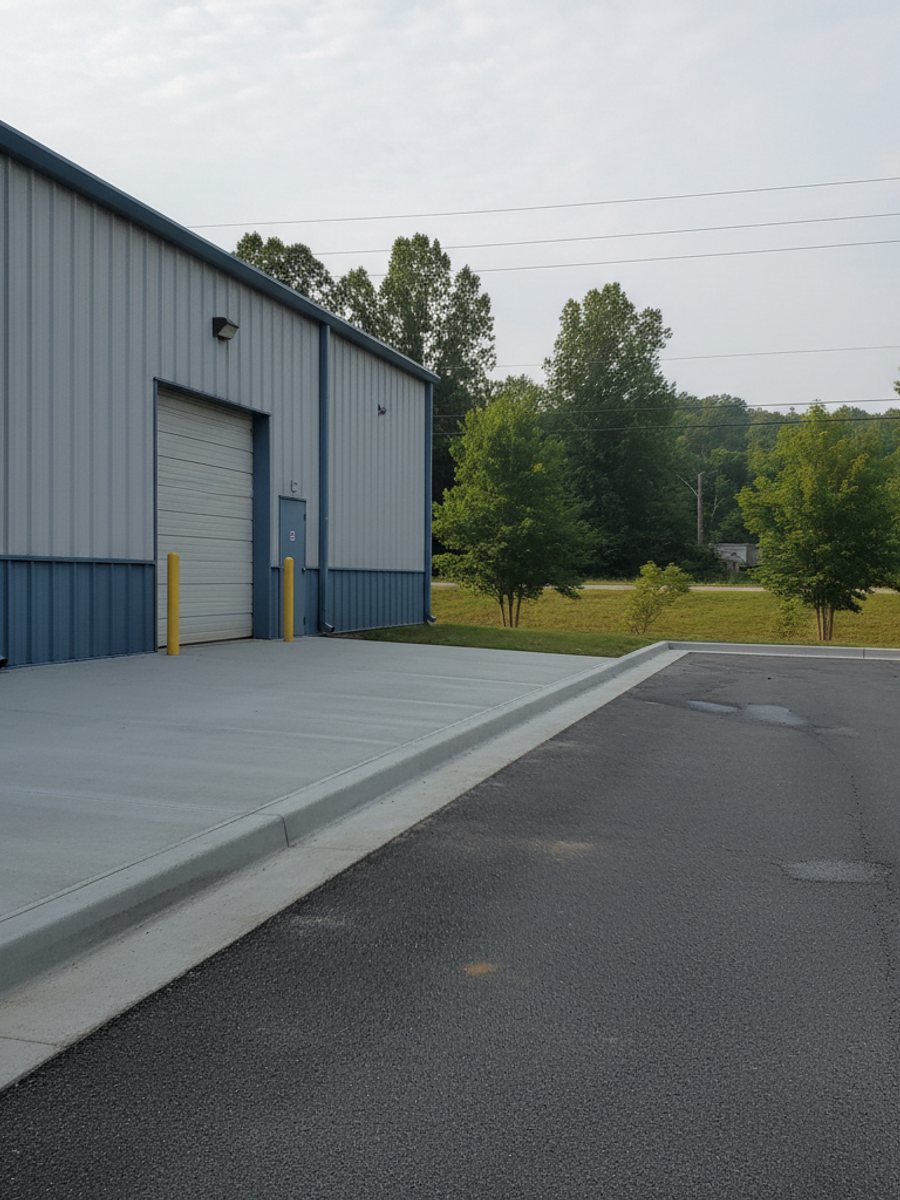
Concrete work looks simple from the driveway. Somebody builds a form, pours gray mud into it, and a few days later you've got a slab. What you can't see is the part that decides whether that slab is still flat and crack-free in fifteen years: the soil prep underneath it, the mix that went into it, and how it was finished and cured. That's where a contractor either knows what they're doing or doesn't, and it's usually invisible until the concrete tells on them.
Why the ground in Wilson County matters more than the concrete
Wilson sits in the coastal plain, and a lot of lots here have clay-heavy subsoil under a thin layer of sandy loam topsoil. Clay holds water. When it's wet it swells, when it dries out it shrinks, and a slab poured on top of that movement without proper compaction will crack along the weak points within a year or two. A contractor who knows the area will compact the base to spec, usually 4 to 6 inches of ABC stone tamped down, before any concrete goes down. Skipping that step is the single most common reason a new driveway or patio in this county ends up with a crack running corner to corner by its second summer.
Older neighborhoods close to downtown, the ones built in the 1930s through 1950s, often have sidewalks and slabs poured with little to no gravel base at all. If you're getting a walkway replaced near a mature oak or maple in one of those older yards, root heave is a real issue too, and a decent contractor will talk to you about root pruning or a flexible joint near the trunk instead of just pouring over the problem again.
What a real quote should include
A quote that just says "driveway, 500 square feet, $X" doesn't tell you much. Ask for the thickness (4 inches is standard for a driveway, 5 to 6 inches if you're parking anything heavier than a pickup or an RV), the psi of the mix (4,000 psi is a reasonable standard for this climate, not the 3,000 psi mix some contractors will quote to save money), and whether it's reinforced with rebar or wire mesh. Wire mesh sinks to the bottom of the pour if nobody's lifting it into place as the concrete goes in, which makes it close to useless. Rebar tied into a grid and chaired up off the base costs more but holds the slab together if a crack does start.
Also ask where the control joints go. They should be cut roughly every 8 to 10 feet, or about 2 to 3 times the slab thickness in feet, and cut within the first 24 hours after the pour while the concrete is still soft enough to control where it breaks. Concrete is going to crack somewhere. The joints are there to decide where, not to prevent it.
Licensing, insurance, and how the pour actually gets scheduled
In North Carolina, contractors don't need a special state license just to pour concrete flatwork, but anyone doing foundation work or structural slabs over a certain dollar threshold should be operating under a general contractor's license. Ask to see proof of general liability insurance regardless. If a truck backs over a water line or a crew member gets hurt on your property, you don't want that landing on your homeowner's policy.
Timing matters here too. Wilson's summers run hot and humid from June through September, and concrete poured on a 95-degree day cures fast on the surface and can crack from shrinking too quickly if it isn't kept damp for the first several days. Winter pours between December and February aren't common but they happen, and a contractor working in that window should be talking to you about cold weather protection if a freeze is forecast within the first 48 hours. Neither season is a dealbreaker. A contractor who doesn't mention either one probably isn't thinking about it.
Permits, setbacks, and the paperwork side
Inside city limits, the City of Wilson's inspections department handles permits for anything structural, like a foundation, a footing, or an addition to a garage slab. A simple patio or walkway replacement usually doesn't need one. A new driveway apron that ties into a public street might need approval from the city or from NCDOT if it's a state-maintained road, since that connection affects drainage and sight lines. Out in the county, on a rural lot off one of the roads toward Black Creek or Elm City, the process runs through Wilson County instead, and setback rules can differ from what's inside city limits. A contractor who's worked here regularly should already know which one applies to your address and won't need you to figure it out.
Newer subdivisions built in the last 15 to 20 years, especially the ones with an HOA, often have their own rules about driveway width, color, or even whether stamped concrete is allowed on the front elevation. Worth a phone call to the HOA before you fall in love with a pattern.
Water, drainage, and what a heavy rain does to a bad pour
Eastern North Carolina gets its share of tropical weather, and Wilson has flooded from remnants of hurricanes more than once, Contentnea Creek rising enough to affect low-lying parts of the county. Most residential concrete work isn't anywhere near that kind of flooding, but everyday drainage still matters. A driveway or patio poured flat, or worse, sloped back toward the house, will pond water against your foundation every time it rains hard, which around here is fairly often in the summer thunderstorm season. Concrete flatwork should slope away from the house at roughly a quarter inch per foot minimum. Stand in your yard after the next downpour and watch where the water actually goes before you hire anyone. If it's pooling against the foundation now, that's a grading conversation to have before a single form goes up.
What to walk away from
- A quote with no mention of slab thickness, psi, or reinforcement, just a total price.
- Anyone asking for full payment up front. A deposit is normal, the balance should be due at completion.
- No written contract. A handshake doesn't specify what happens if it rains the day of your pour.
- A contractor who can't tell you when they'll saw-cut the joints or how long before you can drive on it. Light foot traffic is usually fine after about 24 to 48 hours, but a driveway shouldn't see a car for at least 7 days, and it needs the full 28 days to reach its design strength.
- Reluctance to give you a couple of addresses of past work you can go look at in person. A slab that's held up for five years in this soil says more than any sales pitch.
Concrete work is one of those trades where the mistakes are permanent and expensive to fix. A slab that's cracked or holding water can sometimes be patched, but a lot of the time the real fix is tearing it out and starting over correctly. Worth the extra week of asking questions before the truck shows up. If you want a second opinion or a straight answer on what your yard actually needs, Horizon Concrete Co is happy to walk the site with you before anything gets poured.